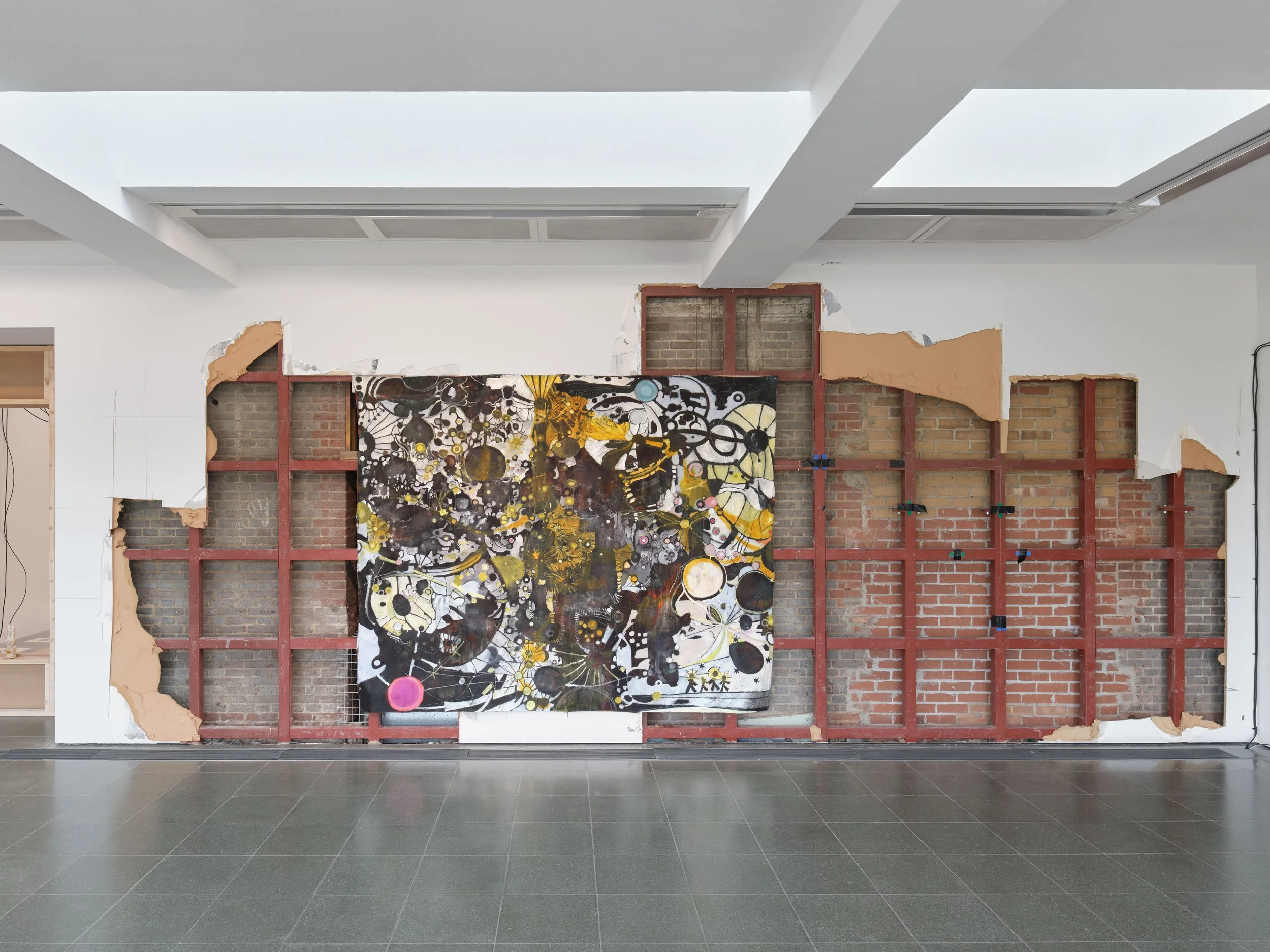
Justin Caguiat: Change Ringing, installation view, Serpentine South, 2026. Courtesy Serpentine. Photo: George Darrell.
Justin Caguiat’s Change Ringing brings painting, sculpture, printmaking and sound into dialogue with Serpentine South’s exposed architectural fabric. When the artist first visited, the gallery was already beginning a phased renovation; the stripped walls offered an unexpected way to engage with the building’s infrastructure and accumulated material histories.
In conversation with Kavan Balasuriya, Natalia Grabowska, Curator at Large, Architecture and Site-Specific Projects, describes how these circumstances enabled the exhibition, how the Serpentine team supported its realisation, and why the experience sharpened her understanding of site-responsive practice and trust in the artist. Change Ringing is on view from 8 October 2026 to 10 January 2027.
KAVAN BALASURIYA: Sursuma is interested in art, architecture, materials and the histories that objects hold. Since we are speaking from a curatorial and institutional perspective, I’m curious about what happens when an artist works not simply within a gallery, but through its physical and operational conditions: the conversations, considerations and negotiations involved in developing the exhibition.
NATALIA GRABOWSKA: It was an extremely exciting opportunity for me personally and for us as an institution. To give you some context, my title is Curator of Architecture and Site-Specific Projects, and I work on the Serpentine Pavilion, which falls under exhibitions. I work in the exhibitions department, but from my first year here I found that architecture and exhibitions with an architectural dimension were closer to my heart, even though I don’t have an architectural background.
When Justin, who is predominantly a painter, came for his first site visit, we were renovating one of the galleries. We had taken down the plasterboard walls in the central gallery, which hadn’t been done since the last renovation in 1996, and he saw an opportunity. We explained that we would eventually need to renovate the other galleries, and he wanted to work with that condition.
There is obviously a certain aesthetic to it, but for him it was conceptual. Very early on, he told me that he wanted to work with the gallery beyond its interiority: to plug directly into our infrastructure and expose parts of the building that hadn’t been seen before. He is very interested in material histories and the alchemy of materials, so it was a wonderful opportunity.
When we stripped the plasterboard from the three remaining galleries, we discovered traces of previous renovations: different materials used to block exits, and signs of people who had worked there, including a bottle someone—perhaps a technician—had left behind. The building carries this embedded history.
As we began hanging the paintings, we saw the architecture almost absorbing them. Some of the exposed shapes left by the removed walls resembled shapes in the paintings. That was a wonderful visual surprise. Justin also considered other architectural details. In the central gallery, where the round thermochromic works hang, we changed four rectangular windows into round ones. He wanted architecture to be an active participant. Unless you know Serpentine very well, you might not even notice that the windows have changed.
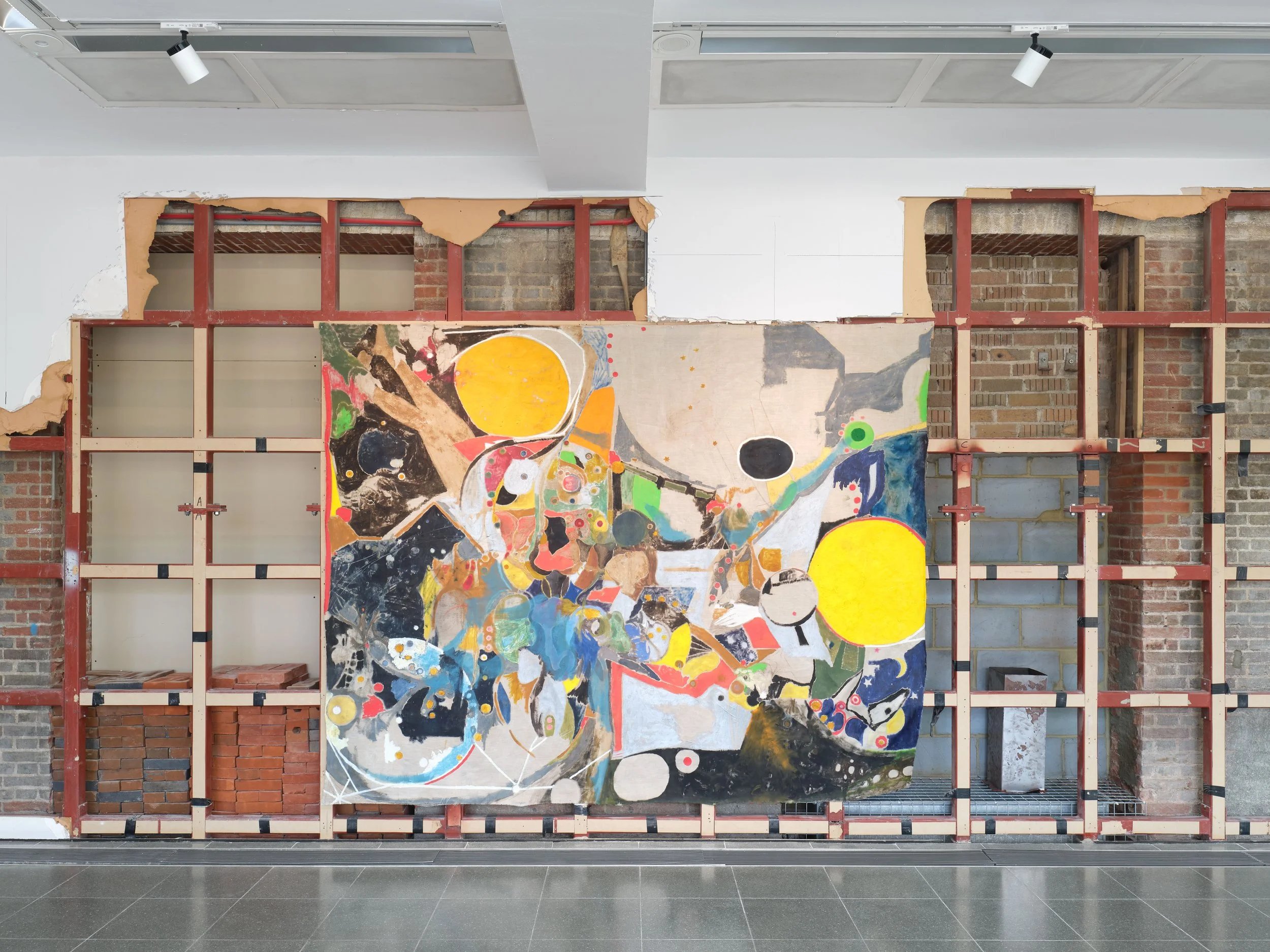
Justin Caguiat: Change Ringing, installation view, Serpentine South, 2026. Courtesy Serpentine. Photo: George Darrell.
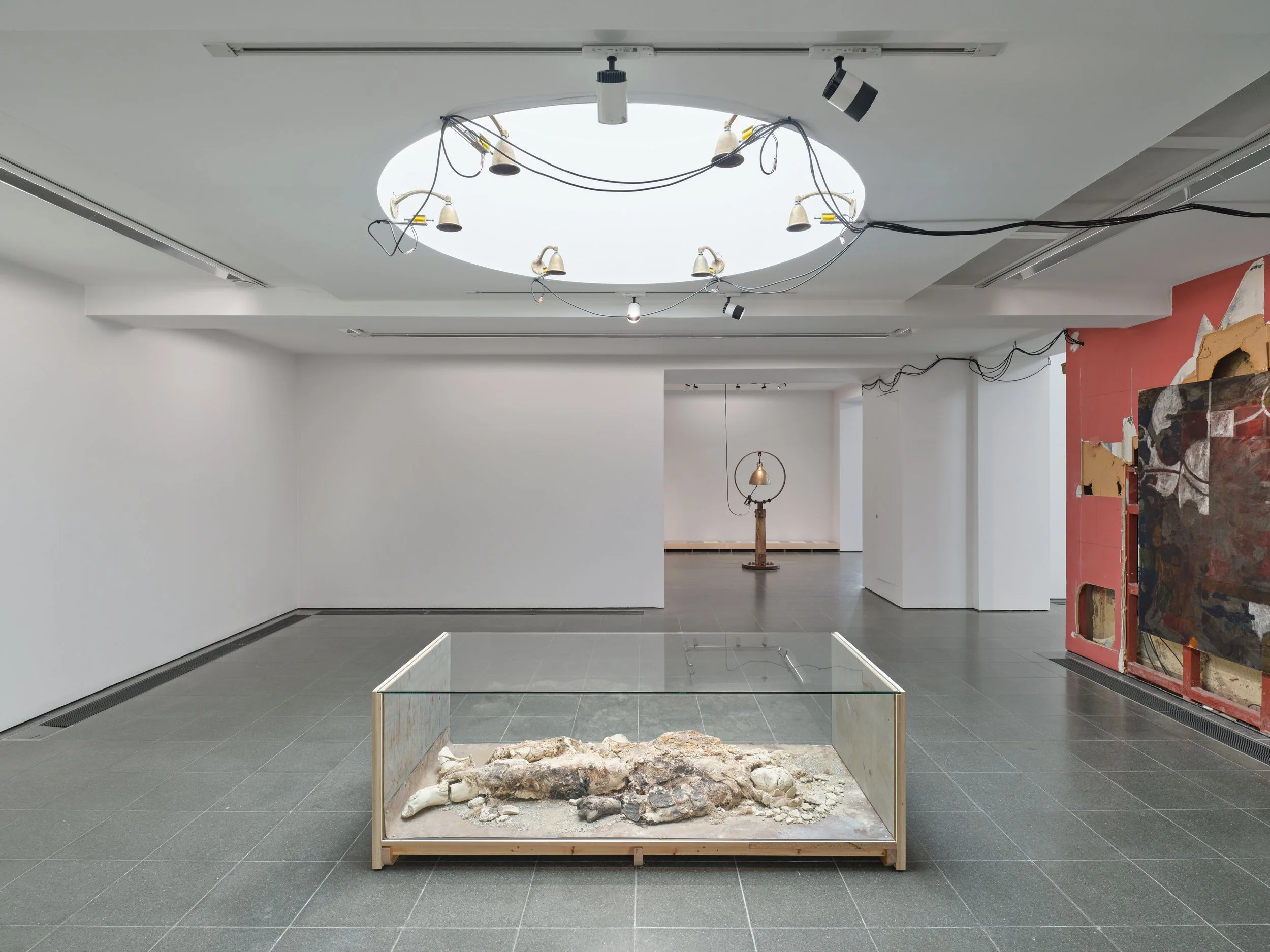
Justin Caguiat: Change Ringing, installation view, Serpentine South, 2026. Courtesy Serpentine. Photo: George Darrell
KB: The round windows complemented the dome so well.
NG: Exactly. I had seen images from before the 1996 renovation, and many of the skylights used to be round. The skylights in what we call the east and west galleries—the perimeter galleries—are rectangular now, but in documentation of the Jean-Michel Basquiat exhibition here in the 1990s, you can see their earlier round forms. These little details let us play with the building's history in a nuanced way, without pointing directly to it.
KB: Just to clarify, the gallery is undergoing a renovation now?
NG: Yes, exactly. We are doing it in phases, during installation periods between shows. The space hasn’t really been renovated since 1996, but doing everything at once would mean closing the gallery for too long. Justin arrived at a wonderfully serendipitous moment.
KB: Will the interventions made for this exhibition remain? For instance, will the circular windows stay?
NG: I think they will go back to being rectangular, unless the next artist wants them to remain round.
KB: The heat, sound, draped wires and changing materials make the whole building feel almost like a living system. Given its history as a tea pavilion, did anything of that earlier building remain?
NG: If you look at historical images of the building as a tea pavilion, you can now recognise parts of walls that had been buried beneath plasterboard and are exposed again. But there wasn’t a direct reference to the café as such.
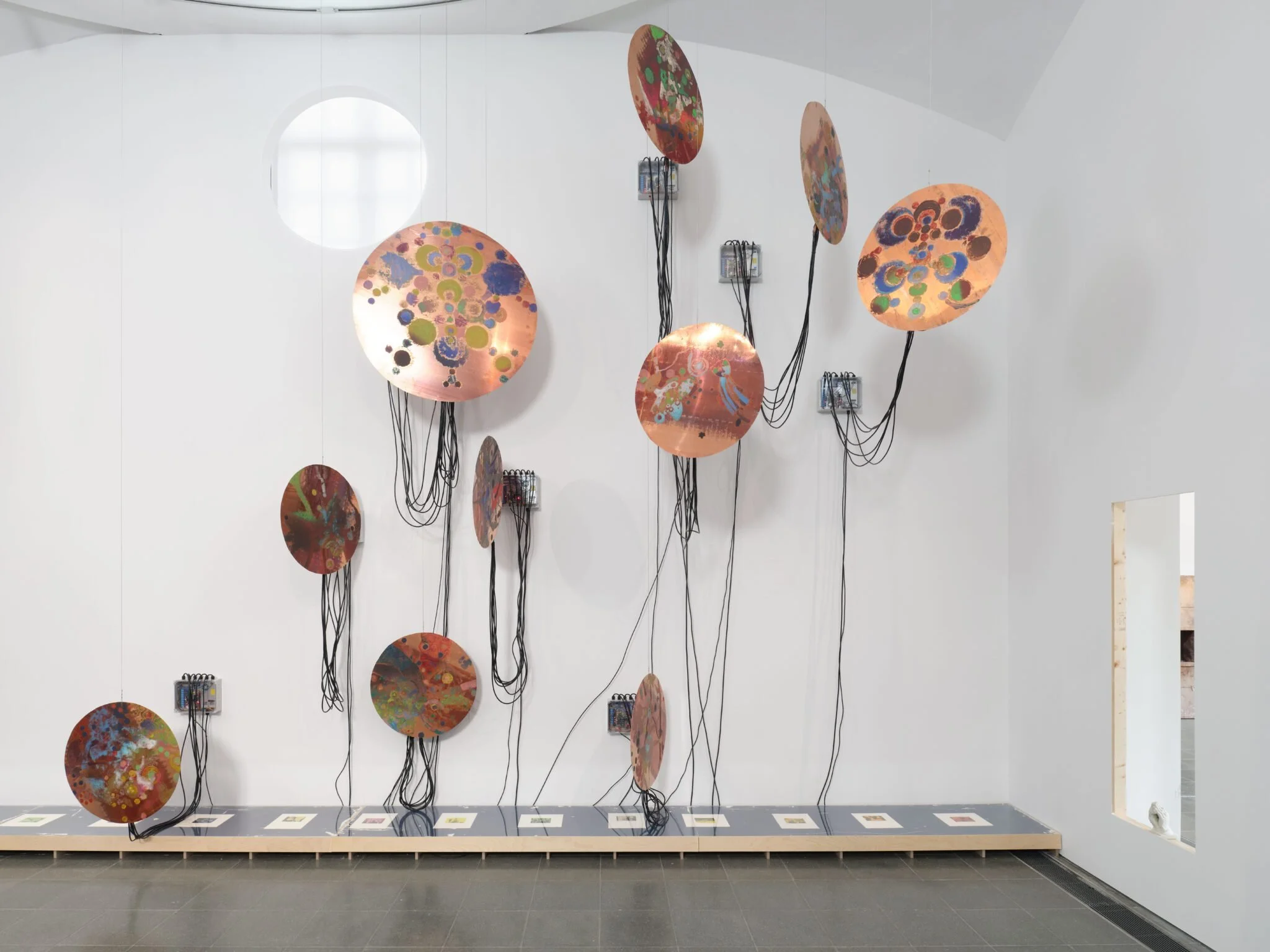
Justin Caguiat: Change Ringing, installation view, Serpentine South, 2026. Courtesy Serpentine. Photo: George Darrell.
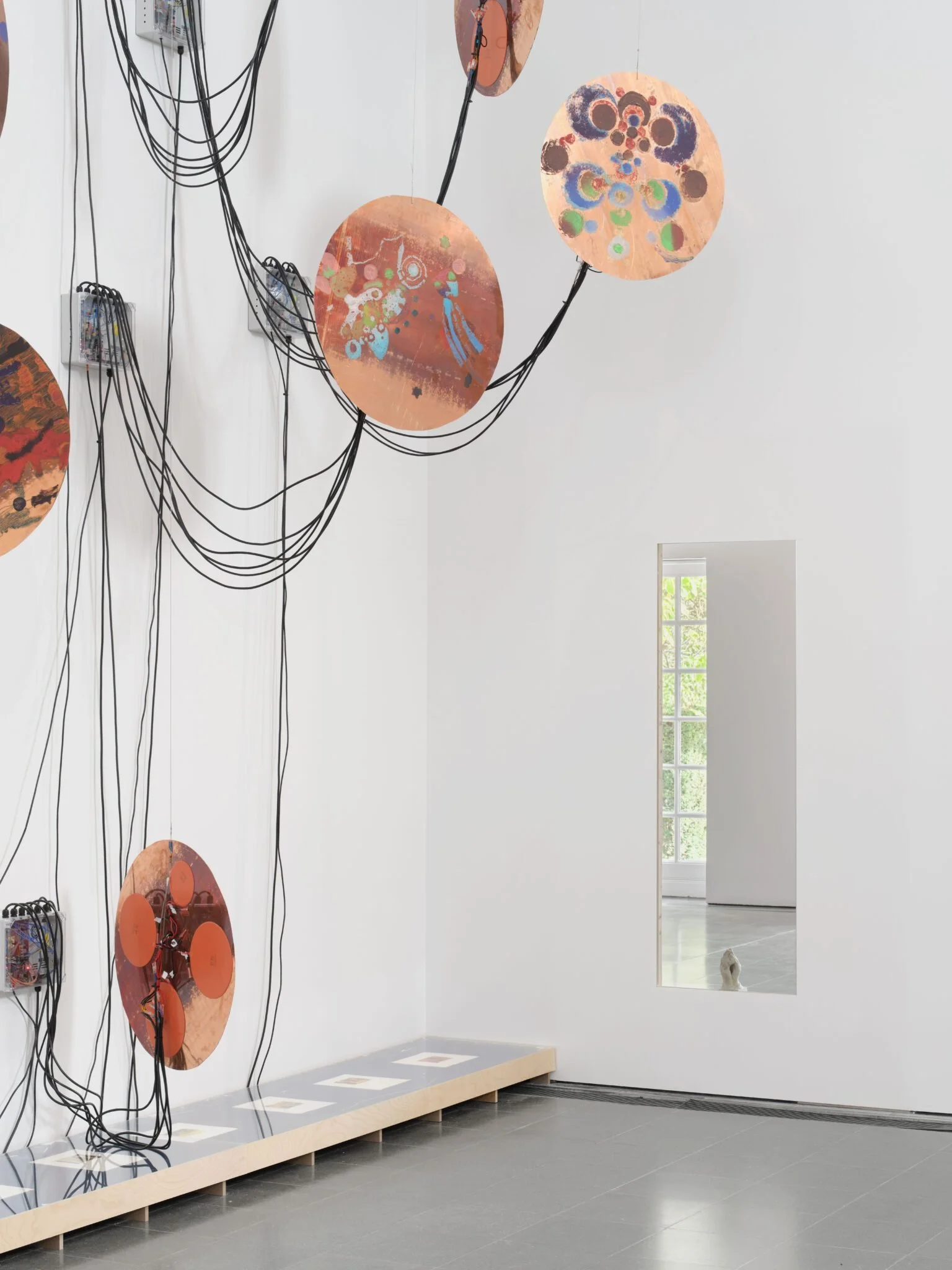
Justin Caguiat: Change Ringing, installation view, Serpentine South, 2026. Courtesy Serpentine. Photo: George Darrell.
KB: Were there difficulties or negotiations around what Justin wanted to do and what was allowed? What considerations or institutional constraints affected its final form?
NG: Not so much, because the timing was so fortunate. We tend to see challenges, or things outside our usual remit, as opportunities. Serpentine is almost the perfect size for artists to treat it as a place of experimentation. We can realise things here that might be difficult in a much larger institution.
We needed to take these walls down anyway. Normally we would have rebuilt them, and nobody would ever have known. Instead, Justin could work with that process. We have a brilliant production team that's up for every challenge, and they made it happen the way he wanted.
KB: Justin speaks about exploring architecture through sound. How did that translate into his decisions about the surfaces, openings and positioning of the bells? Did anything emerge from testing them in space?
NG: The bells and the music are closely tied to his interest in architecture. He said to me that if we were really going to engage with architecture, we needed to bring in sound. I loved that, because sound changes how we experience spaces as much as materials do.
He had made a bell installation before, in a church in Madrid, but on a much smaller scale: a freestanding installation of six bells. At Serpentine, he could consider the space itself as an instrument. Exposing the walls was important, because different materials resonate with sound differently or reflect it differently. Rather than making a freestanding sculpture in one room, he dispersed bells throughout the gallery, turning the entire Serpentine into an instrument that both plays and receives.
That connects with Le Corbusier’s idea of a building as an acoustic receiver. Sound changes the way you move through the exhibition: you hear a bell in the distance and become curious about where it is coming from. The bells are installed at different heights and in different places—some very exposed, others almost tucked away in a nook.
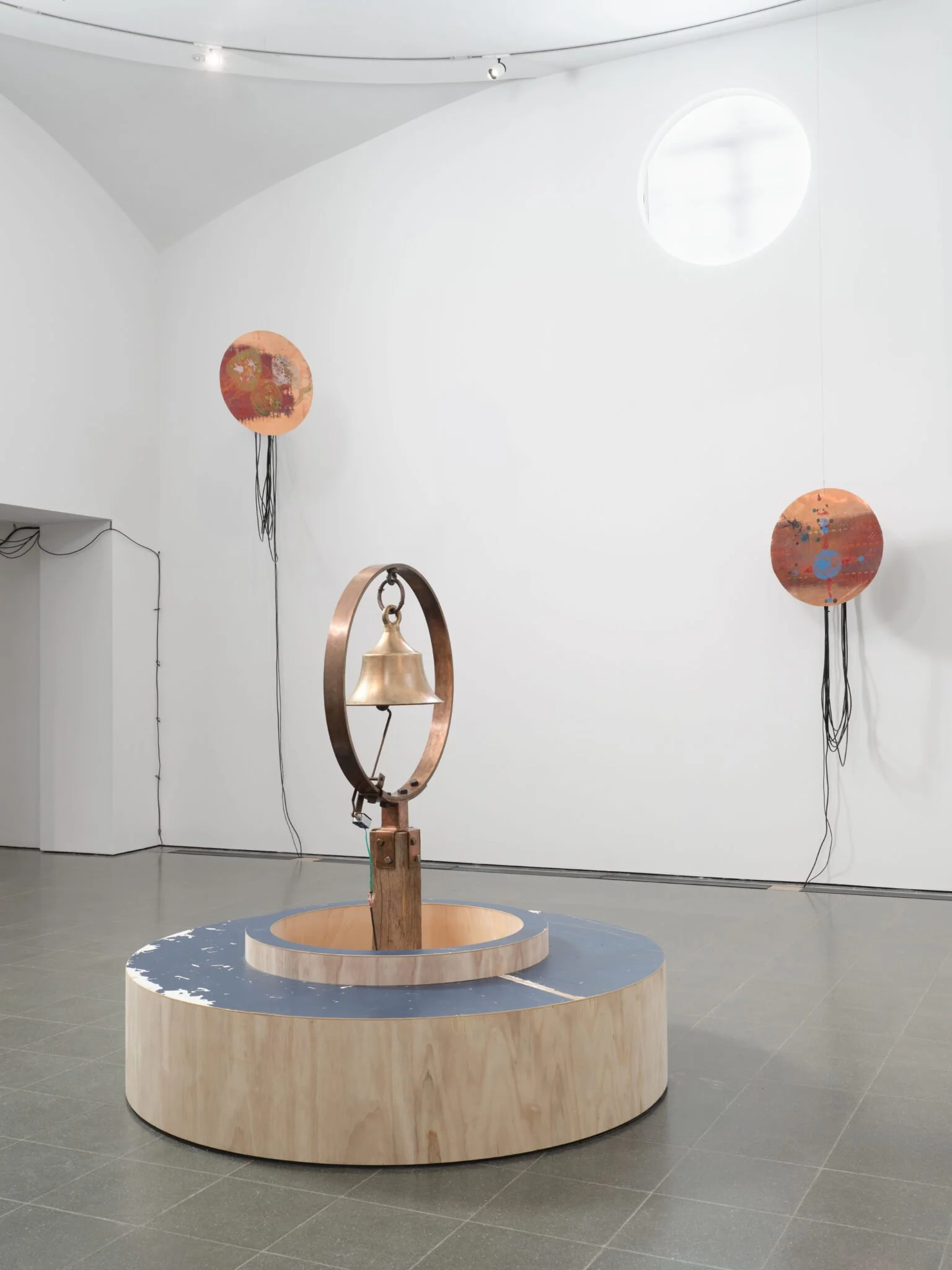
Justin Caguiat: Change Ringing, installation view, Serpentine South, 2026. Courtesy Serpentine. Photo: George Darrell.
KB: How have visitors responded? Entering the exhibition is such a sensory encounter. I wondered about how people move through the rooms and the range of reactions the sound might produce.
NG: There is a very visceral response, both to the sound and to the sight of the exposed materials. We receive summaries of visitors’ comments at the end of each day, and people do notice the bells. Many have described them as healing, or said that the space feels meditative and has completely transformed how they look at the paintings. Other people get slightly agitated by them.
I read both reactions positively. I would rather have a strong reaction, even annoyance, than visit an exhibition and feel nothing. I think visitors have been pleasantly surprised because many expected a much more straightforward painting exhibition. We have done something quite different. It feels as though we have enabled another layer of Justin’s practice that hadn’t been explored in this way before.
KB: There is an interesting question of collective authorship here, involving artistic production, curatorial practice and institutional infrastructure. Did Justin make new bells for the show? And did working in this space change anything about them?
NG: The majority were made for this exhibition. Only six had been shown previously in Madrid. They were cast after different flowers and plant seeds, chosen partly for their properties. Angel’s trumpet, for example, is associated with delirium-like states and can be toxic or fatal. I think Justin is interested in that idea of an alteration of state, and you can see it across his work.
As you mentioned, with the lost-wax process and the Russian Orthodox bell-casting technique, you don’t know exactly what tone you will get until the casting is complete. Initially, Justin imagined two installations, one in each oculus. After seeing the gallery, he decided it would be better to spread the bells out. We still have them in the oculi, but also in doorways, on walls and as freestanding objects. Thinking in a site-responsive way has changed how they sound. They sounded very different in Madrid.
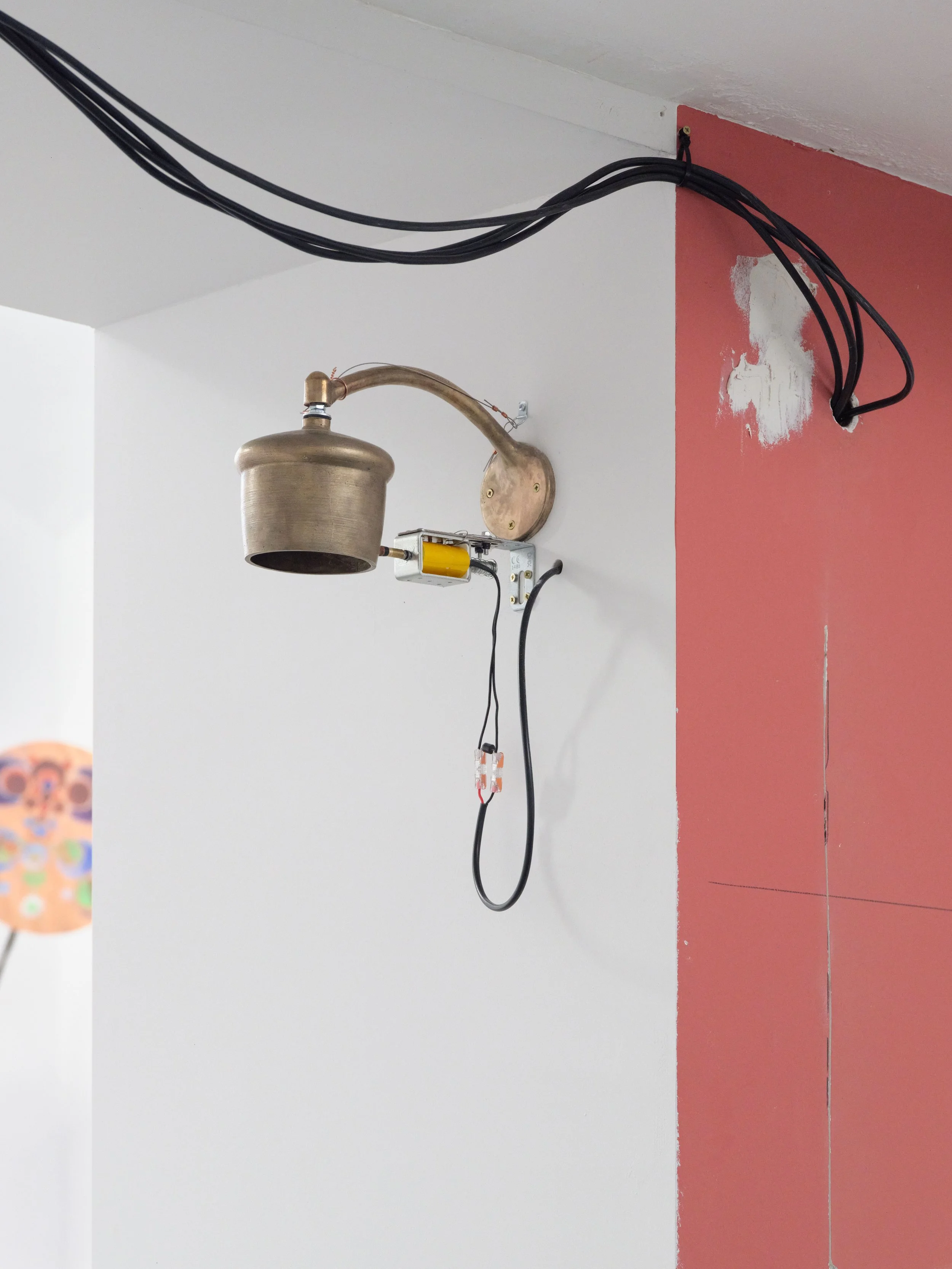
Justin Caguiat: Change Ringing, installation view, Serpentine South, 2026. Courtesy Serpentine. Photo: George Darrell.
KB: Has this changed the way you think about site-specificity in your curatorial practice, or perhaps from the institution’s perspective?
NG: I don’t know if it has changed my understanding so much as widened it. I prefer the term “site-responsive”. Site-specific can suggest adjusting the work to fit a site, whereas site-responsive means responding to the possibilities the site offers.
Working with someone who does that across so many mediums and gestures has been a dream, because of the music, the materials, and the paintings. Some changes are subtle, like the round windows, which simply make sense and make the architecture feel active. We also installed corrugated or fluted plastic over the windows looking out to the park. By diffusing the view, it makes the park another active participant. You suddenly notice it differently.
It extends to the furniture and display structures. We made those using walls from our previous David Hockney exhibition. We retained materials during deinstallation and gave them another life, bringing a different layer of material history into the show.
KB: Was reusing those walls an institutional decision, or did Justin suggest it?
NG: Justin made that decision. The starting point wasn’t necessarily sustainability. It came from his interest in materiality and a particular aesthetic in his work. In a recent exhibition in San Francisco with Rafael Delacruz, whom he often collaborates with, he made a bench from cardboard and wood. He frequently uses materials from his studio to make objects, and he thinks of those objects as extensions of his practice, just as a painting made in the studio is.
Because he was working here, he asked what we already had and what we could use. We happened to have these beautiful walls.
KB: I had a personal response to the space. The entrance is dramatic: exposed walls and paintings seem to merge, the bells sound, and that coffin-like figure stands in the corner by the entrance. Elsewhere, the dark form of the kiln beside the large red painting felt almost foreboding. I found the exhibition calming, but the stripped walls and baked figures also suggested a degree of violence. Has that come up in other visitors’ readings?
NG: Yes, a few people have mentioned something similar. We come to an exhibition with whatever is happening in our lives and in the world. It is difficult to separate what you have been thinking about that day from what you see in a gallery. You could read the walls as a world that has been destroyed, or the central figure as being in a state of decay.
For Justin, I think these are more acts of creation than destruction. All the sculptures in the exhibition are made from bread, including the human figure. I think he was thinking more about archaeological finds. The small figure in the corner, for example, takes its form from the Kewpie baby on the Japanese mayonnaise brand’s logo. That figure can look a little sinister, so the undertone is there, but the reference also comes from something everyday.
One of my favourite sculptures is the little bunny in a doorway opposite the praying hands. Justin takes familiar figures, shapes and objects and puts them almost on a pedestal, breathing a kind of sacred quality into them. So I can understand the reading of violence, but perhaps it is more about Justin being punk than about violence itself.
KB: I love what you said about everyday objects and the little rituals people attach to them. I suppose my underlying question has been how an institution and an artist negotiate an exhibition in which the building’s history, systems and impending changes become conditions of artistic production.
NG: I love it when artists push us. I’ve been at Serpentine for almost a decade, and that is what keeps it exciting. My last three shows were Barbara Kruger, Peter Doig and now Justin. They are very different artists, but each really transformed the space and considered what would make sense there, how to use it and how to bring emotions out of people through their work in that particular setting.
It has been incredibly rewarding to be pushed beyond what an art gallery would usually do.
KB: What have you learned from working over time with such different artistic practices and their engagement with this space? Was anything unusual in Justin’s case?
NG: What I keep learning is how to look at and frame the work in a way that makes sense for the artist, rather than for the institution or for me. Of course, I have my own interests, my sense of aesthetics and the research I care about. But I have learned to let go of that a little, to focus on the artist and ask: “What makes sense for you?” Not: “What makes sense for us?”
There is still a great deal of collaboration and exchange. But with experience, I have learned to trust the artist and follow their vision. Sometimes I disagree, or I don’t immediately understand a proposal. Then I have to ask myself why the artist believes it will work. Sometimes my role is to suggest how we can best achieve what they want. Ultimately, I have learned to trust the artist.
KB: Was there anything unresolved in the exhibition, or anything more you would have liked to do?
NG: In an ideal world, perhaps we could have taken over more of Serpentine—gone into the lobby, the bookshop and other spaces Justin might have been interested in. There are always time and resource constraints. I love it when a project can engage with the entirety of a building rather than just the gallery rooms. With Barbara Kruger, for example, we installed sound pieces in the bathrooms and the bookshelf. Sometimes you need that extra push to take something one step further.
In Justin’s case, the exhibition is also unresolved in an interesting way. It is experimental, and he has worked with techniques that are new to him. I don’t mean that it is conceptually unresolved; I think the concept is very resolved. But the reading of the works remains open. You can resolve them again and again, depending on what you bring to them.
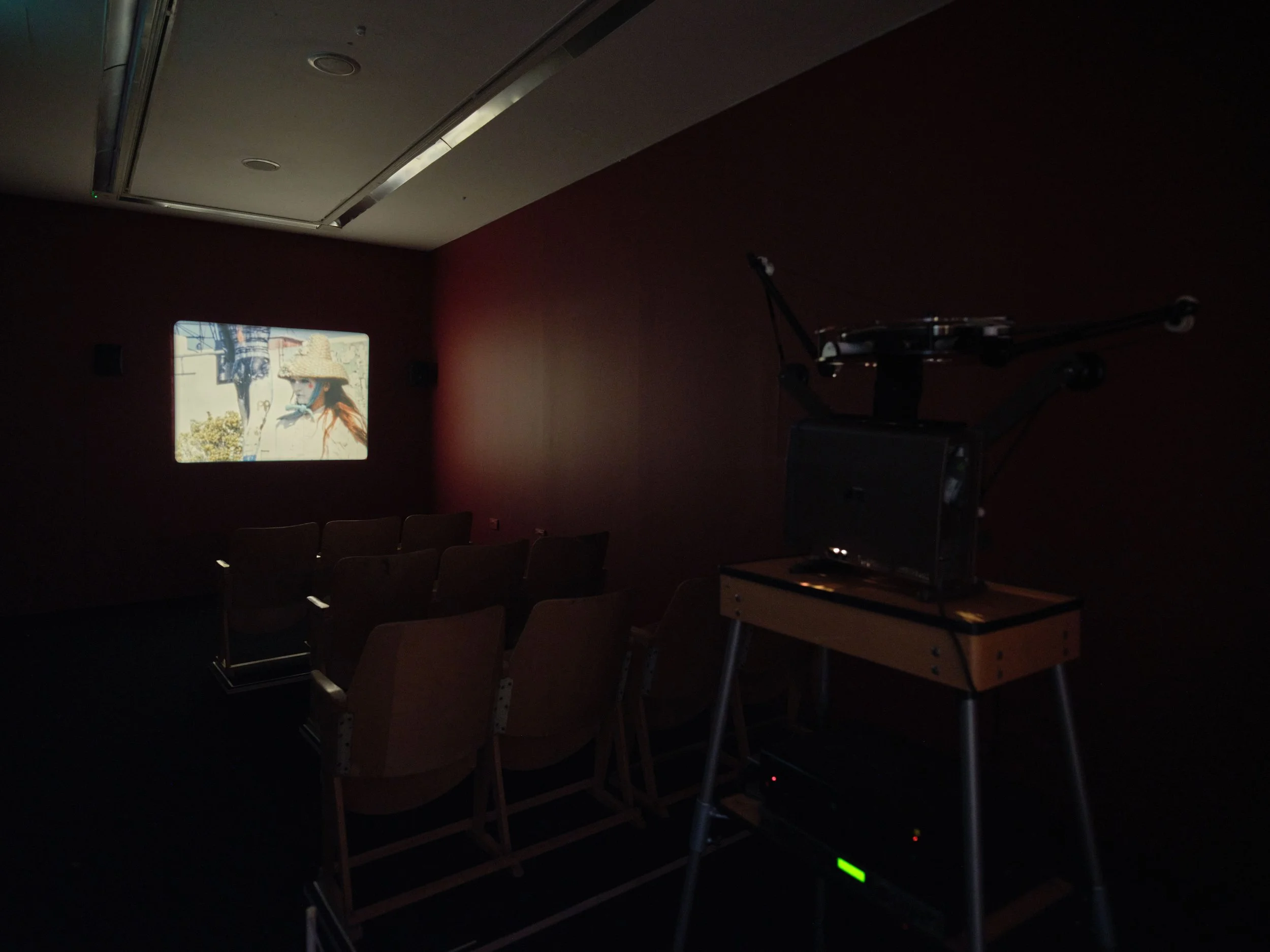
Justin Caguiat: Change Ringing, installation view, Serpentine South, 2026. Courtesy Serpentine. Photo: George Darrell.
KB: Given how transformative the process is, and how much is in flux, Justin may see a very different exhibition by the end.
NG: Absolutely. We are looking into touring the exhibition, which is exciting because it wouldn’t be the same show somewhere else. It would be almost another chapter. That is something we haven’t pushed through yet, but I hope we will.
KB: And would you be directly involved with a future presentation?
NG: Yes, we would be involved. Usually, when our exhibitions tour, there is a set list of works, and another institution might add a few pieces, or the artist might want to make something new. Normally, the task is to adapt the exhibition to another space. In this case, it would almost mean rethinking it for an entirely different museum. That would be a very exciting challenge.
KB: Do you have any locations planned?
NG: We have a list of potential partners we are looking at, but nothing is confirmed yet.
KB: How long did it take to develop Justin’s exhibition? Are those conversations with artists usually conducted over years?
NG: With Justin, it was about a year and a half, perhaps. Our lead times vary. A year is probably the shortest; three years is also common. But sometimes we are in conversation with artists for seven years or more. We may have done a live programme with an artist and kept them in mind until the moment is right.
That happened with Peter Doig. The conversation was already active when I started at Serpentine, but we knew we didn’t want to do just another beautiful painting exhibition. Then came the idea of showing his paintings with music, and suddenly it was the right moment. You can enter an artist’s world through that kind of project. I think that is true of Justin’s exhibition too: it opens up something of his world and his references.
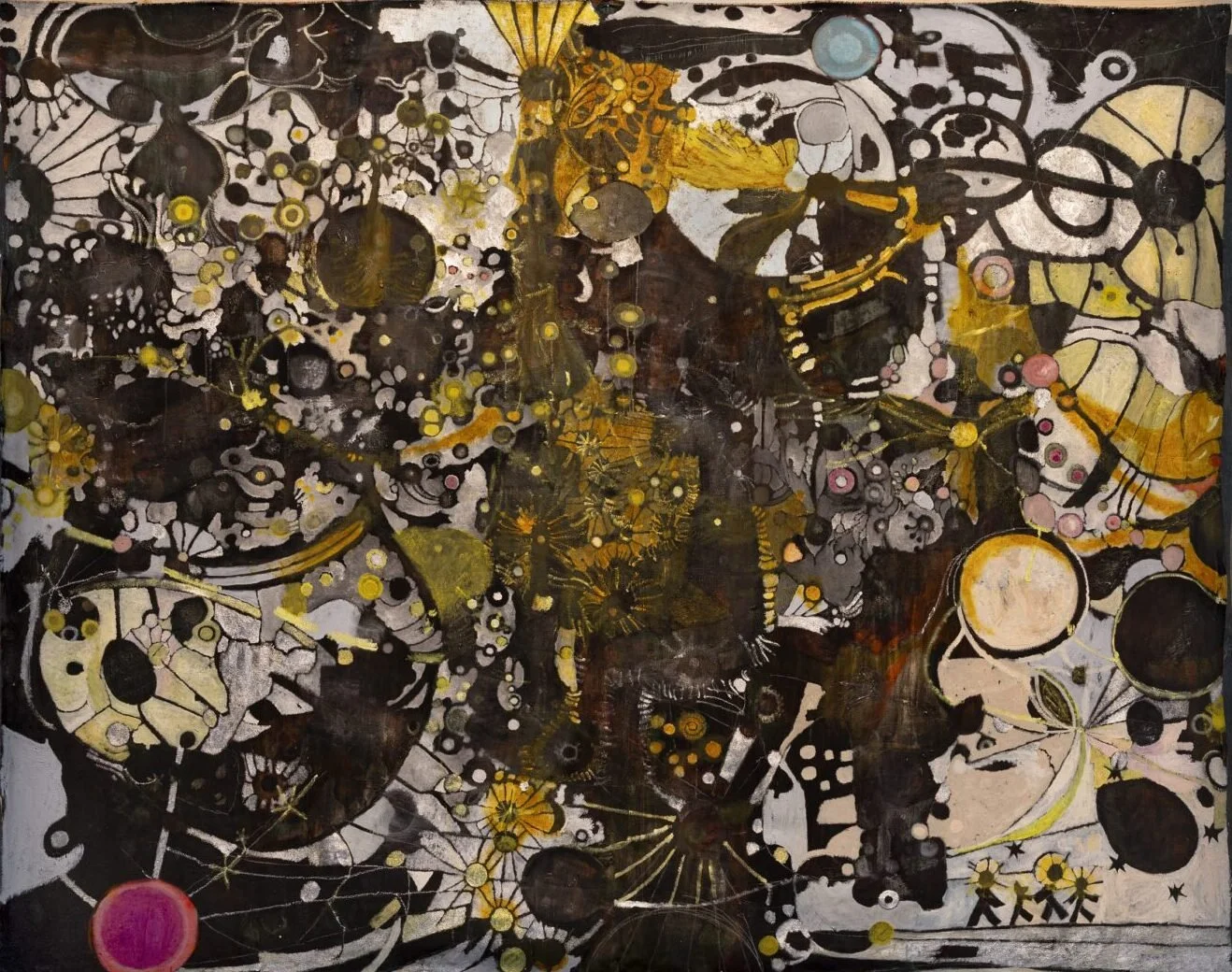
Justin Caguiat, Forensics with Air, 2026 Oil, chalk, pigment on linen 231.1 x 284.7 cm, Courtesy Sandretto Re Rebaudengo Collection; Greene Naftali and Modern Art.
KB: Were the heat pads and the thermochromic paintings on copper difficult to realise or maintain?
NG: So far, they have been working well—touch wood. They were challenging, or at least very interesting, for Justin to make. Because the pigment was so reactive to UV light, he painted them in almost complete darkness. He had methods and guides; it wasn’t blind work. But when he finished, I asked for photographs, and he said he didn’t really know how they looked yet. That uncertainty was part of the process.
It was his first time working on copper with those thermochromic pigments. The copper itself became an important feature: you can see areas of oxidation and the material's structure. The support became part of the painting.
KB: Were the thermochromic pigments used on canvas as well, or only on the copper works?
NG: Only on the copper works.
KB: You mentioned that he used something like stencils. How did he approach the painting process?
NG: Not quite stencils. For some of the copper works, he painted certain elements onto a plastic sheet, placed the sheet on the copper plate, adjusted it, and worked over it.
KB: The circular motifs felt rhythmic, almost like pulses. I wondered how much sound and vibration might have influenced them.
NG: Round forms recur throughout Justin’s practice. In almost any painting, you can find circles that he sees as a network of nodal points, or entry points, from which everything begins or radiates. They are even more present in this exhibition because he was very inspired by the Catedral de Justo in Madrid, where there are many circular motifs.
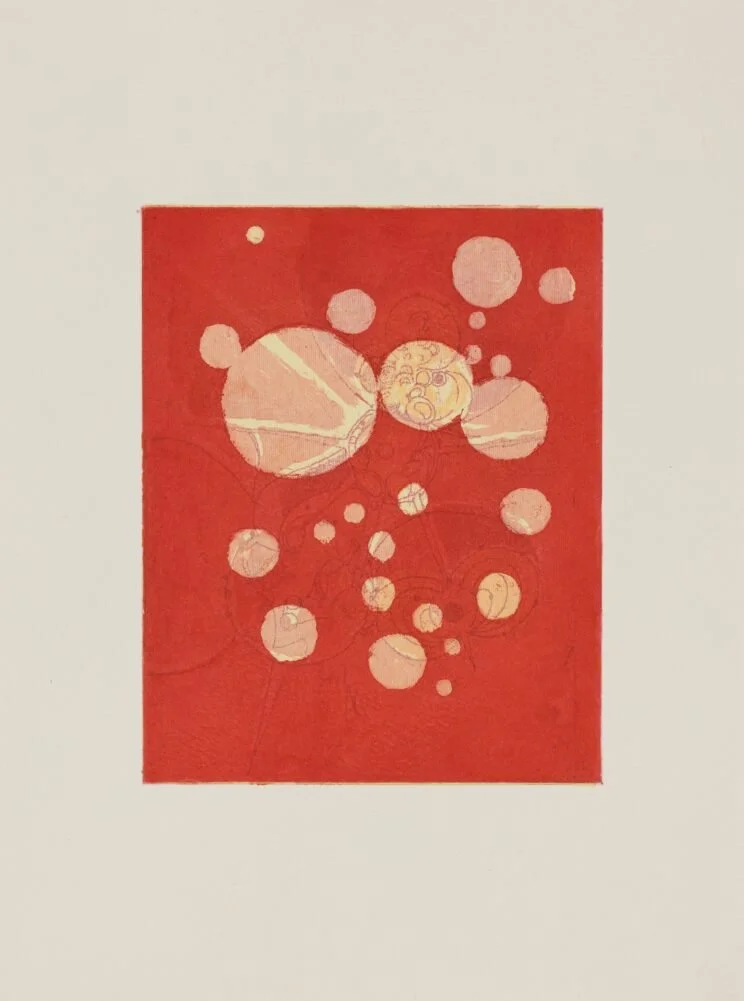
Justin Caguiat, Untitled 7 (Alphabet of Dots), 2025, Aquatint and soft-ground etching, gampi paper chine collé over monotype on paper, 35.2 x 26.5 cm. Courtesy the artist; Greene Naftali, New York; Modern Art, London; and Serpentine, London.
KB: The circular interventions on the corrugated plastic between the park and gallery also echo those shapes. Can I ask why Justin? How did his work first attract your attention?
NG: I love that question because I remember the first time I saw one of his paintings. It was a few years ago, at what I think was Condo or a similar initiative. I walked into what was essentially a group exhibition, knowing nothing about the artist, and felt immediately drawn to a painting.
I thought it must have been made by someone very mature—perhaps an artist in their eighties or nineties—because it combined extraordinary complexity with a clarity of vision. Those two qualities together are rare. For some reason, I also imagined the artist was a woman who hadn’t been shown very much. Of course, I later learned who Justin was.
I followed his work, and Hans Ulrich Obrist met with him a few years ago. The conversation developed from there. Justin had ideas about going beyond the work he was already making, and the timing felt right. One of Serpentine’s programme strands gives younger or emerging artists a platform to realise something they haven’t done before. That was the case here: the timing, the work and the concept aligned.
KB: Could you say something about the complexity of his compositions? Was there a particular state or approach he was exploring in their pictorial space?
NG: Much of it relates to the Catedral de Justo and the biography of the man who built it. Justo Gallego Martínez was a self-taught builder who designed and constructed that extraordinary building himself. The paintings are never simply “about” one thing, but Justin conceived and painted many of them during a period when he was spending a great deal of time in Madrid.
He has also said that Goya’s Disasters of War and Black Paintings were important influences. Perhaps that brings us back to your earlier question about violence and the references that may be present in the work.
I love the way these paintings resist our desire to make sense of them. You look and think you can see a hand, or something suggesting a hand. Just as you begin to recognise it, the image stops making sense, or your eye moves somewhere else. I feel almost deliberately confused by them, but in a very intelligent way. There is the suggestion of a hidden figure, but it never fully reveals itself. Something always throws you off, even if it is simply a splash of colour.
KB: I had a similar experience of recognising fragments of figures and then losing them in the abstraction. Was there anything particular in the presentation of his experimental prints and etchings?
NG: Printmaking is a really important part of Justin’s practice, particularly because of how he works with the techniques. He intentionally misuses established printmaking processes. Some prints are on handmade or invented papers of his own, some are made very traditionally and beautifully, and some are photographic. You might see the same shape or image approached through quite different techniques.
It gives you a glimpse of how he works. In bending the rules, he brings emotions out of the materials and finds a deeper artistic value in them.
KB: That really hits the nail on the head. We all bring the context of our lives and our emotions into the studio. I’m interested in how bending the rules can allow some of that to emerge—breaking open a safe container, in a way, while still channelling it through a process. Thank you for sharing that.
NG: Thank you.