404.zero
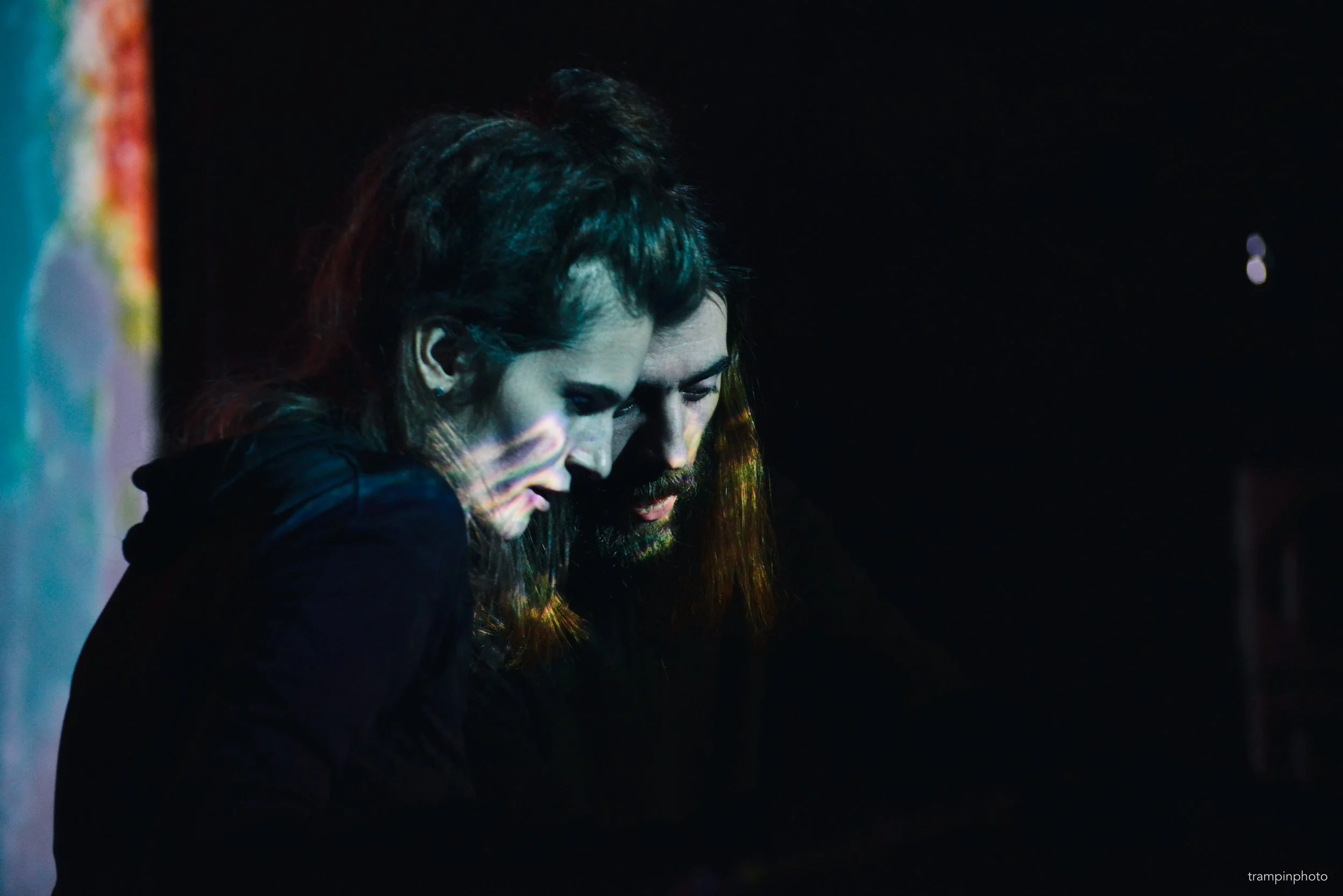
404.zero, portrait by Ivan Dolnikov.
404.zero: Kristina Karpysheva and Aleksandr Letsius
This accomplished and ever-ambitious duo of A/V architects and toolmakers cook up mind-altering experiences in generative art that require expertise in math, coding and the science of sound. By creating mesmerizing digital matter of frighteningly porous frontiers exclusively through TouchDesigner and modular gear, they push back the limits of footage and sample-free language that is opulent and breathtakingly singular. Taking as starting points their most irrepressible fascinations with death, the unknown and the cosmos, they craft thrilling, precise, painterly code-art that broaches big philosophical questions and provides mesmerizing though highly speculative answers.
Together, Kristina and Aleksandr create modern generative art and innovative tools that raise the bar on the synergistic possibilities of visuals and sound. Since meeting at Moscow’s Mars Contemporary Art Centre in 2016, they’ve collaborated on a slew of immersive affairs, always up for the challenge of conjuring new things—modular music, generative visuals, and TouchDesigner tools.
Given their immaculate rep for shaking up paradigms in modern generative art, it was only a matter of time before these digital diviners brought their modular memories of an opulent and disembodied future.
They participated in many international festivals and exhibitions in Russia, Germany, Indonesia, USA, Peru. Including Dark Mofo, MUTEK festival, GAMMA Festival, Electric Castle Festival, LACMA, Moscow Planetarium, Orpheum Theatre LA e.t.c. 404’s works were selected by Japan Media Arts Festival and awarded by Genius Loci Weimar Festival, IMAP festival.
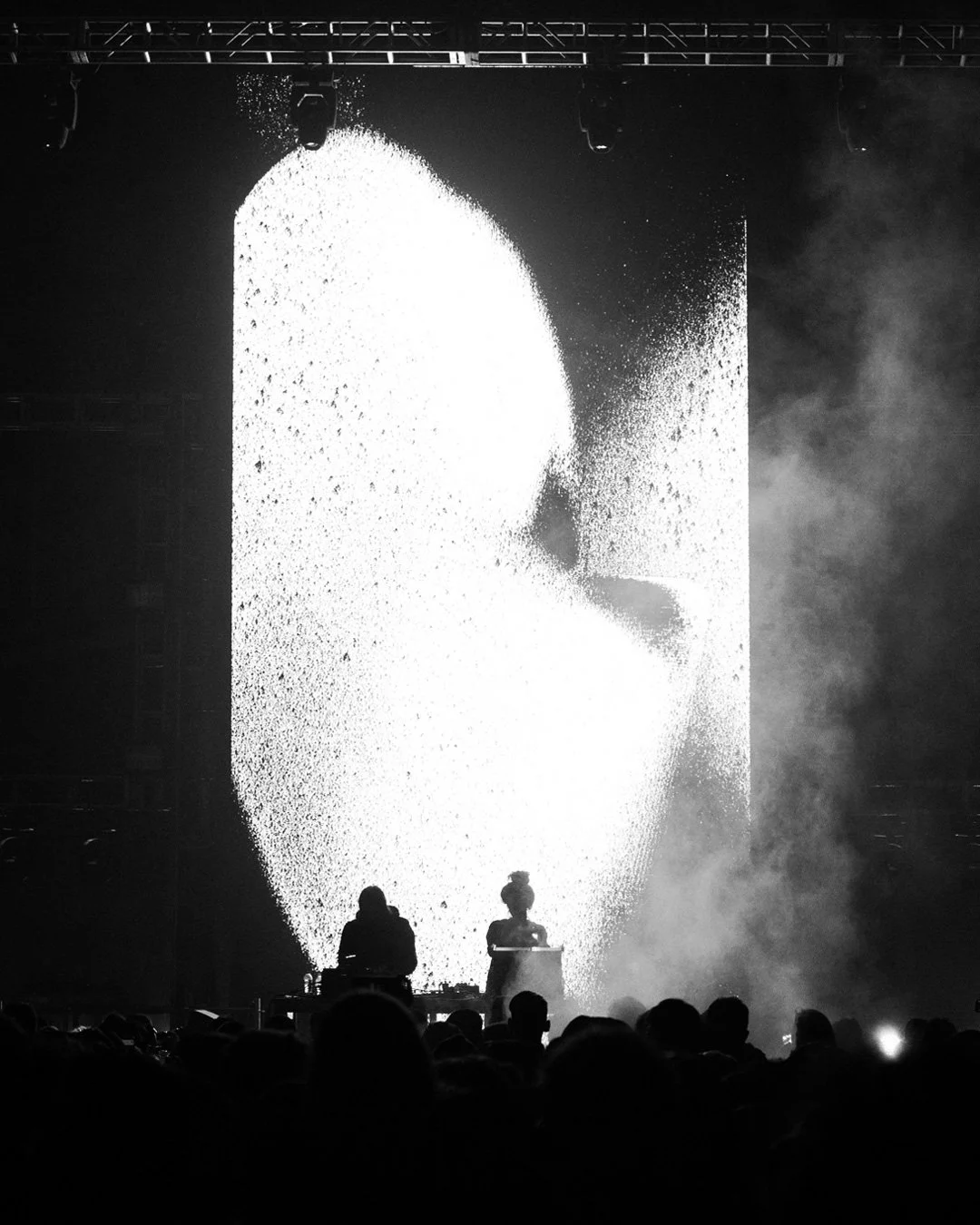
Image credit: Diego Figuero.
AMBER HANSON: The name 404.zero suggests both an error and a point of origin. How does this notion of ‘zeroing’ shape your artistic philosophy? Does it represent working from the starting point of absence and creating by using the building blocks of binary code? Or is there an alternative meaning?
404.zero: For us, “zeroing” is less about binary code in a literal sense and more about a state of reset: clearing the existing narrative, erasing the expected content, and seeing what appears in that gap. We are interested in the moment when a system fails or returns an error, because that’s where new meanings, new structures and new perceptions can emerge.
So rather than illustrating digital logic, the name reflects our artistic philosophy: we work from absence, uncertainty and ‘not found’ states, and build immersive, often algorithmic worlds out of them - as if the error itself becomes the material.
AH: Your installations combine light, code, and sound in ways that feel both architectural and organic. Do you think of light as a structure in itself, or as a material that builds and dissolves form, around form. If you had to akin light to a body part for example would it be more like the skeleton or the skin?
404: We often perceive light and sound as independent substances, just like people - regardless of whether they come to experience the work or not. They are not merely tools or effects, but presences with their own internal logic and behaviour.
In our works, these substances share one common ground of existence: this particular space and this particular moment in time. Within this shared field, they form structures that interact with one another - sometimes they support each other, sometimes they collide, sometimes they remain indifferent. Each has the same right to “be here and now”, and at any moment one can address or transform the other.
The metamorphoses that occur between them are similar to life unfolding in the present moment - difficult to fully grasp intellectually, yet available to be felt and perceived.
It is important for us that within the installation a place appears where a person can, even for a brief moment, “catch” their own self - to be alone with themselves, but not in isolation, rather within this shared field. A space that allows them to go a little deeper into themselves than is usually possible in everyday life.
For us, light is therefore both structure and material. It builds a temporary architecture in space - lines, volumes, thresholds - yet also behaves like a living surface that covers, reveals and erases forms.
If we were to compare light to a part of the body, it would be closer to skin than to skeleton - a sensitive, constantly changing membrane where the dialogue between code, sound, space and the viewer becomes visible.
AH: Many of your systems are generative or algorithmic. How do you negotiate authorship and control within a process that is partly autonomous? Do you feel that you have an absolute chance of creating from nothing or more that you are sculpting something that is already there?
404.zero: Many of our systems are generative, but we don’t experience them as “machines that create instead of us”. We experience them more as environments that we co-inhabit. We set the rules, the ranges, the connections between parameters — but once the system starts running, its behaviour often surprises us as much as it does the audience.
For us, authorship is less about absolute control and more about composing conditions: deciding what is allowed, what is forbidden, how elements can react to each other, how they decay or accumulate over time. We sculpt a space of possibilities, rather than every single moment that arises within it. The system has a certain autonomy, but it is autonomy within a frame that we construct very carefully.
We don’t really believe in “creating from nothing”. There is always a field that already exists: knowledge, mathematics, physical laws, our own lives, bodies and experiences, the way we perceive sound, light and time. Algorithms crystallise parts of this field - they encode our decisions, intuitions and way of being in the world. Our authorship grows out of how we live, how we move through spaces, how we build a personal dialogue with reality - and only then do we translate all of that into a set of rules, constraints and rhythms for the system.
The only thing we do not take as a primary foundation is other people’s previous works. For us, that is a secondary and very subjective source of knowledge. We see that many artists today build almost entirely on other artists’ work, calling it “inspiration” - or not naming it at all. The question of secondariness and “second-hand creation” is very delicate. At some point, when you are no longer 25, a clearer sense appears of who you are and what you have actually been doing all these years of your artistic path. Have you really been creating - or mostly re-creating, while calling re-creation your own work?
One day everyone will have to answer this question for themselves - and it is better if that answer feels honest and clean.
In this sense, control for us is not a straight line, but a dialogue: we create the system, the system responds, and we decide what to keep, what to remove, and where to allow it to go beyond our initial intentions.
AH: Time seems to unfold differently in your works. Are your installations more like scores, circuits, or weather systems? Something that plays, loops, or drifts? How do they prioritise amongst themselves?
404.zero: Time in our works is never a single straight line; it’s more like several times existing in parallel. Some elements loop, some drift slowly, some react instantly-together they create a field where time becomes dense and heavy in some places, and almost disappears in others.
If we had to choose a metaphor, our installations are probably closest to weather systems. There is structure, but no rigid script from point A to point B. There is a set of conditions under which certain events may happen: intensities rise and fall, patterns form and dissolve, calm phases are followed by “storms”. Within this, there are elements that behave like circuits (strict dependencies, triggers, thresholds), and others that feel like scores (phrases, rhythms, tensions) - but the “performance” is never exactly the same twice.
The question of “what takes priority” is resolved inside the system itself. We encode it through rules, weights and constraints: which signals are allowed to dominate, which must remain in the background, which can interrupt others, which can never exist at the same time. Sometimes a small event produces a huge effect; sometimes a large structure just quietly drifts in the background. There is no single master timeline that controls everything.
The final layer of time belongs to the viewer. Their body, breathing, attention span and personal history become another kind of clock within the installation. Two people can stand in the same space and live completely different durations. We’re interested in the moment when the system’s time and the person’s time overlap - when there is a brief feeling of synchronisation, even if nothing is literally “concluded” or resolved.
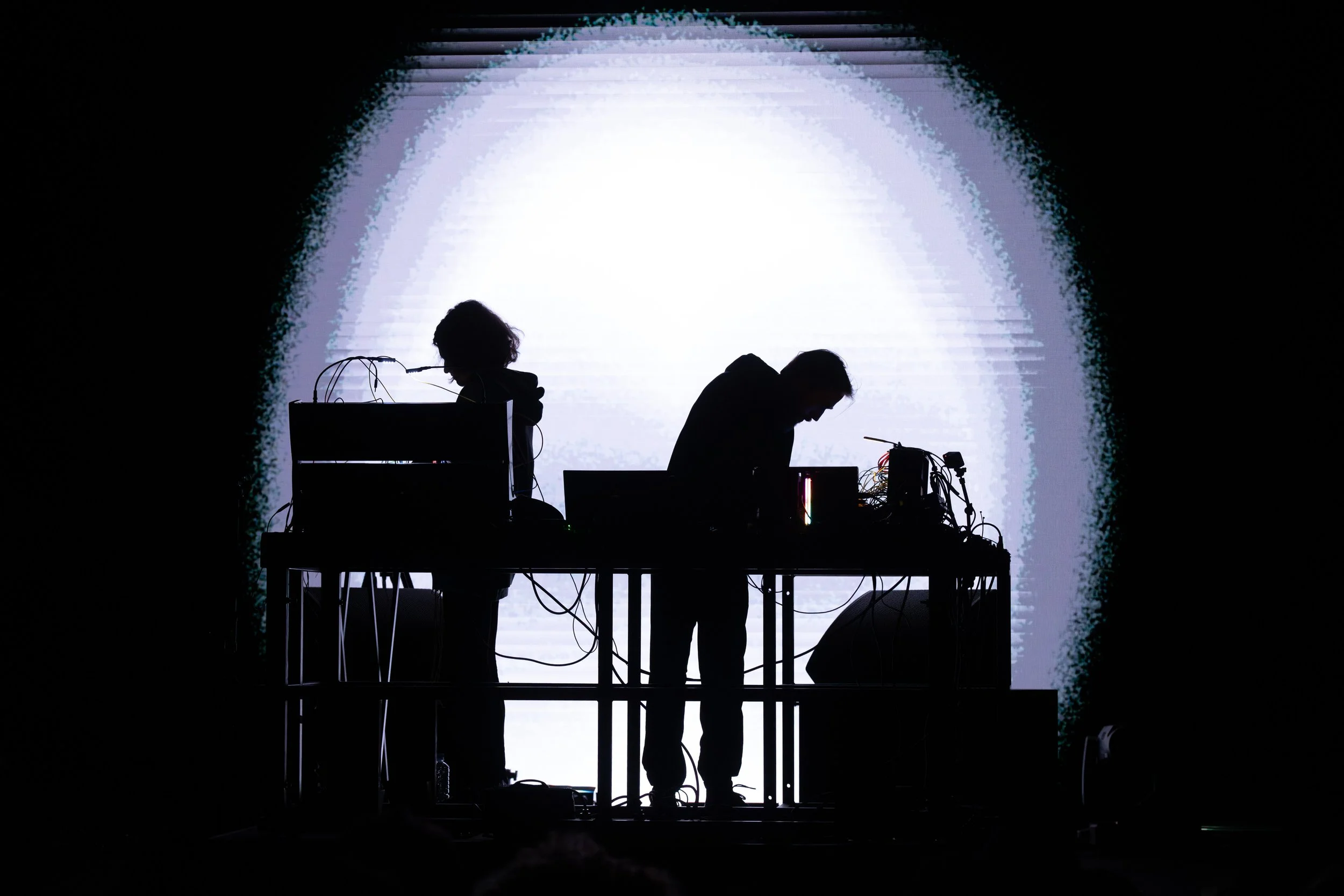
404.zero - ISOTRP, Mutek Tokyo (music festival), Japan.
AH: Light is an immaterial medium, yet it always reveals the materiality of space. Would you say that is true?
404.zero: I’d say it’s true, but only partly and the “missing” part is important for us.
Light does reveal the materiality of space: it pulls out volumes, edges, textures, dust in the air, the distance between bodies. Without light there is no visible architecture, no visible difference between one surface and another. In that sense, light is the condition for material to appear at all.
But light also edits materiality. It doesn’t just show what is there; it decides how it exists for us. It can flatten space or carve it out, make something brutally present or almost invisible. It can erase as much as it reveals - overexpose a surface until it loses detail, plunge something into shadow so it exists more as a feeling than as an object.
In our installations we treat light almost as a substance with its own rights, not just a neutral torch pointing at matter. Sometimes it collaborates with the architecture, sometimes it fights against it, sometimes it ignores it and creates its own temporary structure in the air. So yes, light reveals materiality - but for us, it also constantly rewrites it, questioning what is “real” in the space and what is just a momentary configuration of perception.
AH:There is a striking austerity to your aesthetic, using pure light, minimal form and controlled colour. Is this a technical decision or a philosophical one about reduction, control and precision?
404.zero: It’s both, but the philosophical part came first.
We use reduction because it removes ornament and leaves only what really matters: light, time, space, sound, the body of the viewer. Technically, a minimal, controlled palette also makes complex systems more readable - every small change in light or colour becomes significant, almost like a sentence instead of noise.
AH: In creating these environments, you also build systems that behave beyond human rhythm or scale. Do you see your installations as models of larger natural or technological processes?
404.zero: In some way, yes - but not as direct simulations.
Our installations are not models of a specific storm, network, or ecosystem. They are closer to abstract models of behaviour: accumulation and decay, feedback, saturation, overload, silence after intensity. These patterns exist in nature, in technology, in social systems, and inside the human nervous system as well.
So rather than saying “this is a model of X process”, we think of the work as a microclimate where similar logics become visible and audible for a while. It’s less about explaining how the world works, and more about letting you feel how certain large-scale processes might move through you on a smaller, perceptual scale.
AH: Your practice sits between coding, architecture, and metaphysics. Do you think of your work as speculative as a way of prototyping possible futures of perception or more of a mirror to the contemporary?
404.zero: We don’t really separate these two things.
Our work is always rooted in the present - in current technologies, infrastructures, speeds, anxieties, and ways of paying attention. In that sense it is a mirror: the systems we build often exaggerate what is already happening around us — overload, fragmentation, constant signals, moments of silence that are hard to reach.
At the same time, any experiment with perception is automatically speculative. When you stretch rhythms, remove narrative, shift scale, or let non-human tempos dominate, you are quietly asking:
What if this became normal? How would we sense the world then?
So we don’t try to illustrate “the future”, but we do treat each installation as a small prototype of other possible perceptual regimes - different ways light, sound, time and bodies might relate to each other.
Maybe it’s not a mirror or a prediction, but a third thing: a temporary zone where the present and a few possible futures of perception overlap for a while.