HANNAH WOO
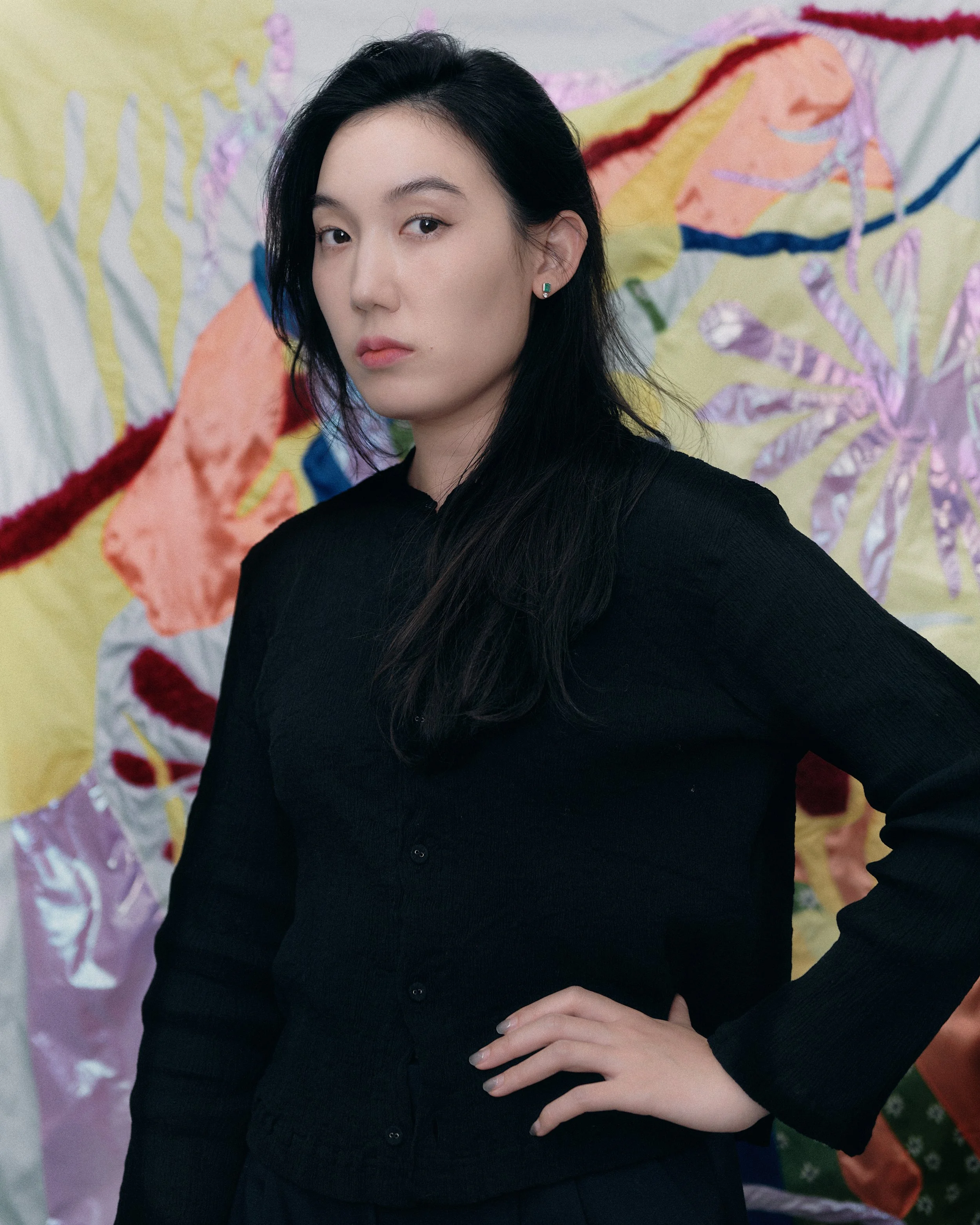
Woo Hannah, 2023, Photograph by Seunghoon Jung. © Woo Hannah, Courtesy of the artist and G Gallery
Woo Hannah (born 1988) received her BFA and MFA from the Department of Visual Art at Korea National University of Arts. Recent solo exhibitions include: POOMSAE (G Gallery, 2025), Appearances (Frieze No.9 Cork Street, London, 2023) as well as Tumbleweeds (BOAN1942, 2023). Her recent group exhibitions include: Layered Medium: We Are In Open Circuits (Manarat al Saadiyat, 2025), SeMA Omnibus: At the End of the World Split Endlessly (Seoul Museum of Art, 2024), Living in Joy (Art Sonje Center, 2023), Summer Love (Song Eun Art Center, 2022), Sculptural Impulse (Buk-Seoul Museum of Art, 2022), and 2020 Next Code (Daejeon Museum of Art, 2020), among many others.
In 2023, Woo received the Frieze Artist Award and her work is part of the following collections: KADIST, Art Sonje Center, DOOSAN ART CENTER, and the Seoul Museum of Art.
AMBER HANSON: Your works often appear to hover between body and architecture, often sewn, suspended, and sagging as if caught mid-transformation. How do you determine a structure’s threshold between stability and collapse?
HANNAH WOO: It feels as if I reach close to the threshold and keep rubbing around it. A state of complete stability, or of complete collapse, can’t be the destination of my work. I make forms that are precariously barely standing, hanging, and drooping.That looks so much like the way I live and work that, rather than saying I decide it, it feels more accurate to call it a matter of fate.
AH: Fabric in your practice behaves as both surface and organ. When you stitch or drape, are you composing anatomically, architecturally, or ecologically? Is there a hierarchy of design that you go to?
HW: It begins with architecture. With movement, curves and inclines, height and thickness, I first imagine how it will support itself, wrap itself, and exist. Then I slowly move into anatomical thinking, varying things by imagining the points where tube and tube open into each other. From unexpected places, something wedges itself into a very suitable spot or gets attached, and I match these points like a puzzle full of humor and surprise, trying this and that.
Even if the rules don’t easily reveal themselves, I want the inherent rules to be felt, and in that way the destination I reach becomes ecological. I follow the ways in which things help one another in order to be composed together. But there are also moments when I find an answer by overturning that order of priority I just described.
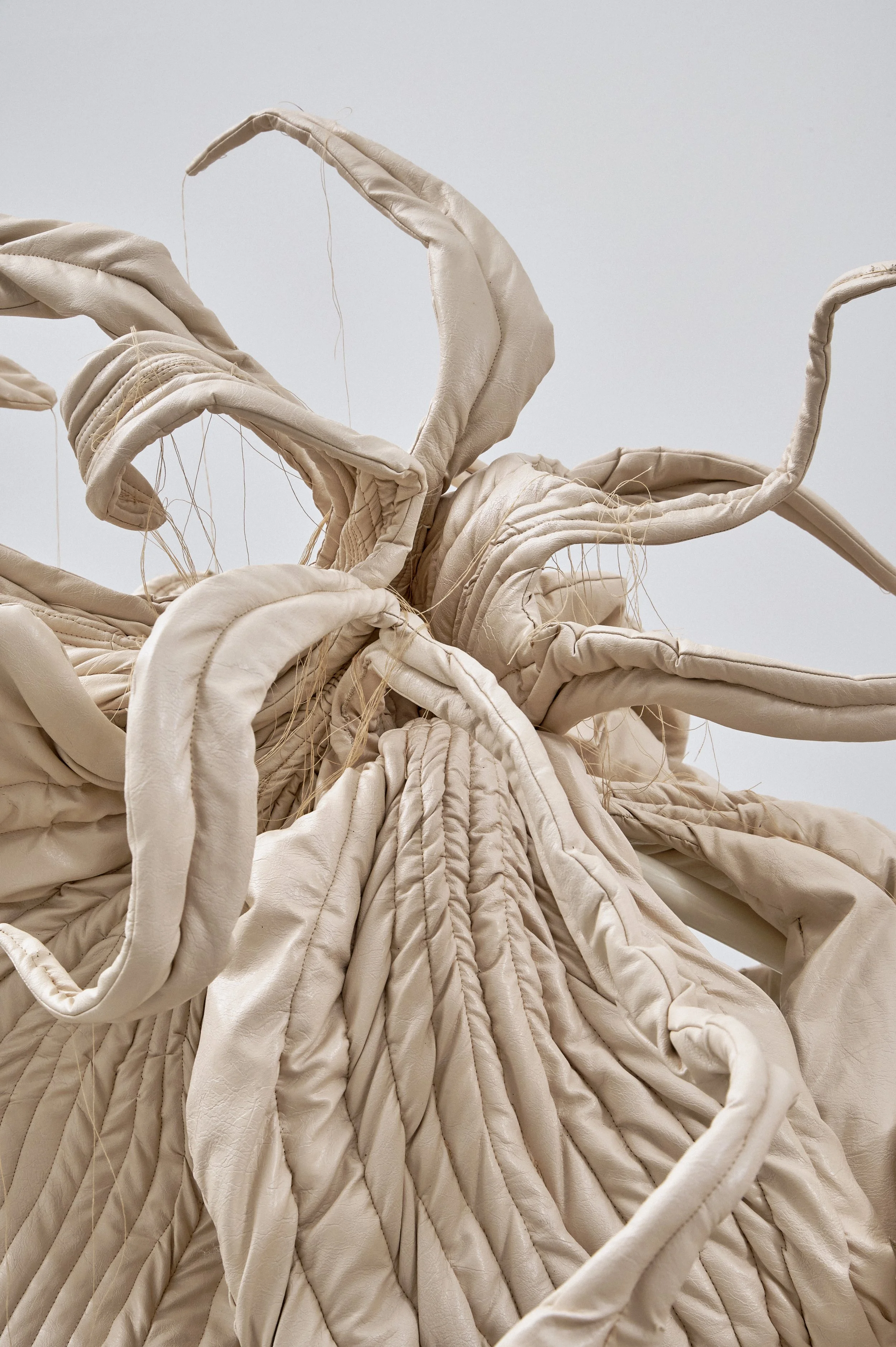
(Detail) Woo Hannah, Twins, Faux leather, thread, stuffing, steel pipe, 130 x 190 x 140cm. 2024. Photograph by Seungheon Lee. © Woo Hannah, Courtesy of the artist and G Gallery
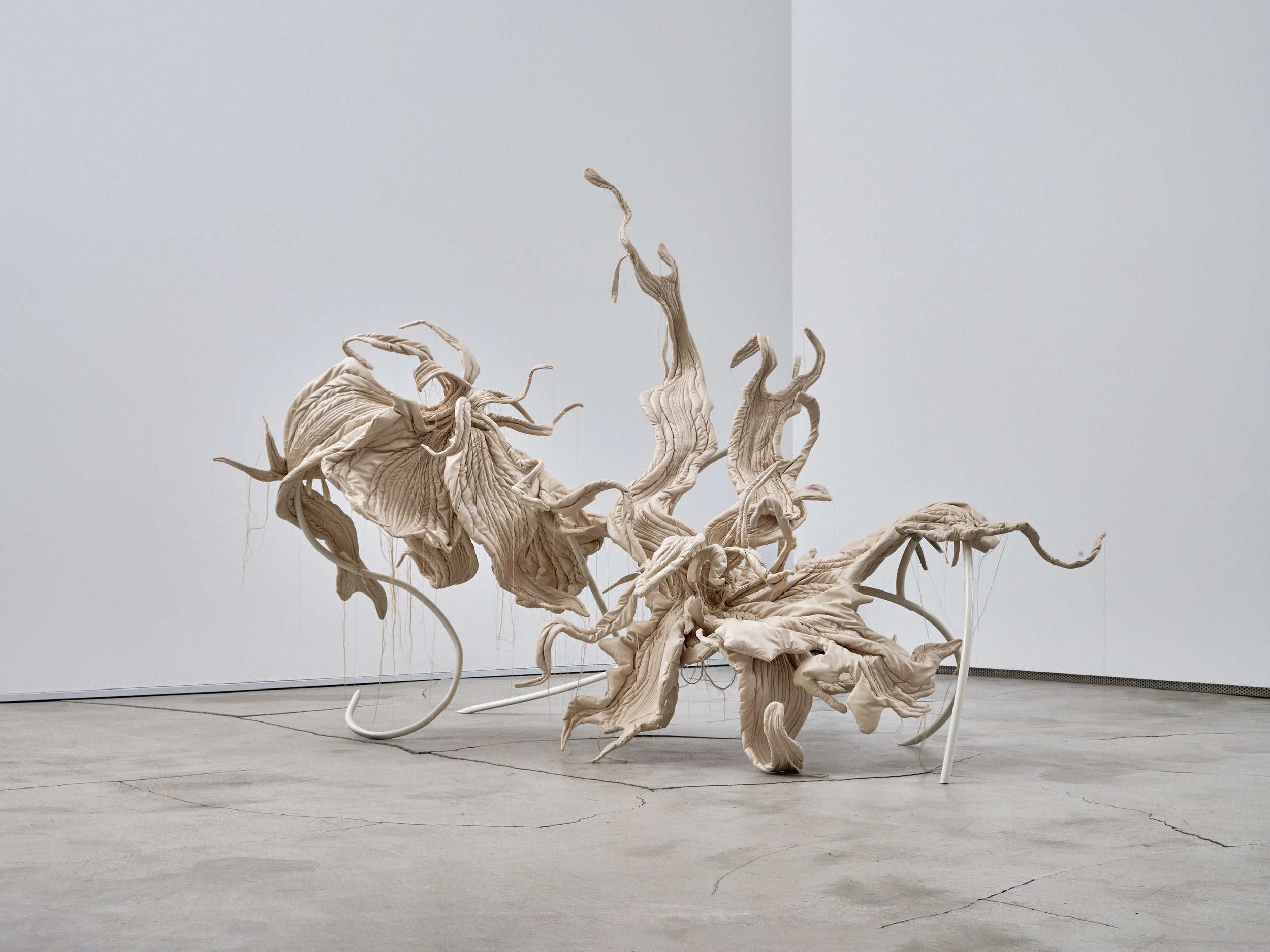
Woo Hannah, Twins, Faux leather, thread, stuffing, steel pipe, 130 x 190 x 140cm. 2024. Photograph by Seungheon Lee. © Woo Hannah, Courtesy of the artist and G Gallery
AH: Many of your pieces reuse or recycle cloth, sometimes industrial, sometimes domestic. What kinds of previous labour or history do you sense in these materials, and how do you decide what remains visible?
HW: At least for the fabrics that arrive in my studio as materials, I tend to erase any sensed concept of labour or history. In the studio I regard them simply as materials for me. I try to look at the appearance and properties of things with different thicknesses and surfaces: their toughness, how much water they absorb or repel, their translucency and sheen, and their colours. I classify them by those qualities and arrange them in my fabric cabinet.
Since there are many recycled fabrics, the amount of a fabric I’ve obtained— something I may never be able to get again—also affects the making. Working according to that has become an attitude in my practice. Sometimes the fabric I’m given is only palm-sized, or sometimes I get three lumps almost the size of a human head, and at times I receive such a large quantity that it feels oppressive. Including the leftover scraps after working, I always collect them in about three boxes and don’t throw them away until they become smaller than the palm of my hand. Those small pieces of cloth that are kept for several years are waiting for the day they will become the one and only toenail of some being I will meet in the future. So the proportion of fabric in my studio trash can is very small.
AH: You’ve spoken about discovering that one of your kidneys had shrunk as a moment that redirected your thinking about normal and abnormal form. How did that bodily experience translate into your spatial and material decisions? And was it an instantaneous change in your making?
HW: I could say it was the moment when, having always looked at that way of thinking only as an observer, I could no longer avoid being a party to it. I used to think I was always looking at things from a certain distance, feeling them, and making stories about them, but after undergoing that bodily experience myself I realised that I had been looking at the world from a kind of lofty point, and that I was no longer in a position to do that. I came to feel keenly how ridiculous the standards and value systems I had maintained about what is physically and mentally “normal” were, and how meaningless it is to divide things into higher and lower. I began to think that those various defects themselves create diversity, and that even if that diversity is not always comfortable, we have to accept it as truth.
That change was bitter for me as a person, but for me as an artist who creates, it became an opportunity for the unconscious self-censorship I had been practising to loosen. I became looser and a bit more free.
AH: Textile work is often associated with touch, but your installations also engage with gravity, air, and time. How do these invisible forces shape what the viewer perceives as “alive” or “aging”?
HW: Textile work is connected to touch, I think, because it really is with us at every moment. From birth until this very moment, and in winter even more so, we wrap our bodies in layer upon layer of substances made of cloth. That tactility is the same in the time we sleep wrapped in a blanket. So fabric inevitably feels closer to the body and like a part of the body. Just as the long hem of a dancer’s costume momentarily extends the line created by a movement, cloth resembles every living body. When we look at a material that comes close to our skin and approaches us in a form similar to our own, it becomes easy to identify the air, gravity, and time it receives with ourselves. On top of that, the lines I create in my work resemble nature. Whenever a mathematical rhythm is felt in the form of a piece, I always try to go to another place by finding humor and unexpectedness.
AH: In a work such as Handy Viscus, the fabric seems to imitate organic tissue while revealing its artificiality. Do you consider these sculptures as models of bodily systems or as autonomous organisms?
HW: In my early works, the viewpoint of seeing them as models of bodily systems was stronger. At that time I really believed you could just swap out or add that part and that would be enough. But as time passed, works that I regarded as independent beings began to appear.
A more Taoist way of thinking became pronounced, where a part becomes a whole and the whole becomes a single independent existence. This always goes back and forth—because I think going back and forth is exactly what is right.
AH:Many contemporary artists use digital or algorithmic systems; you seem to work with an analogue equivalent, the feedback loops of stitch, tension, and slack. How do you understand these tactile systems that mirror our contemporary obsession with forms of computation or control?
HW: For me, it’s the repetition of action and reaction. Only the degree of amplitude and the frequency are unfolded differently, but both the analogue and the “systems of calculation and control that we obsess over today” seem like devices that make the fate each life is born with stand out a little more.
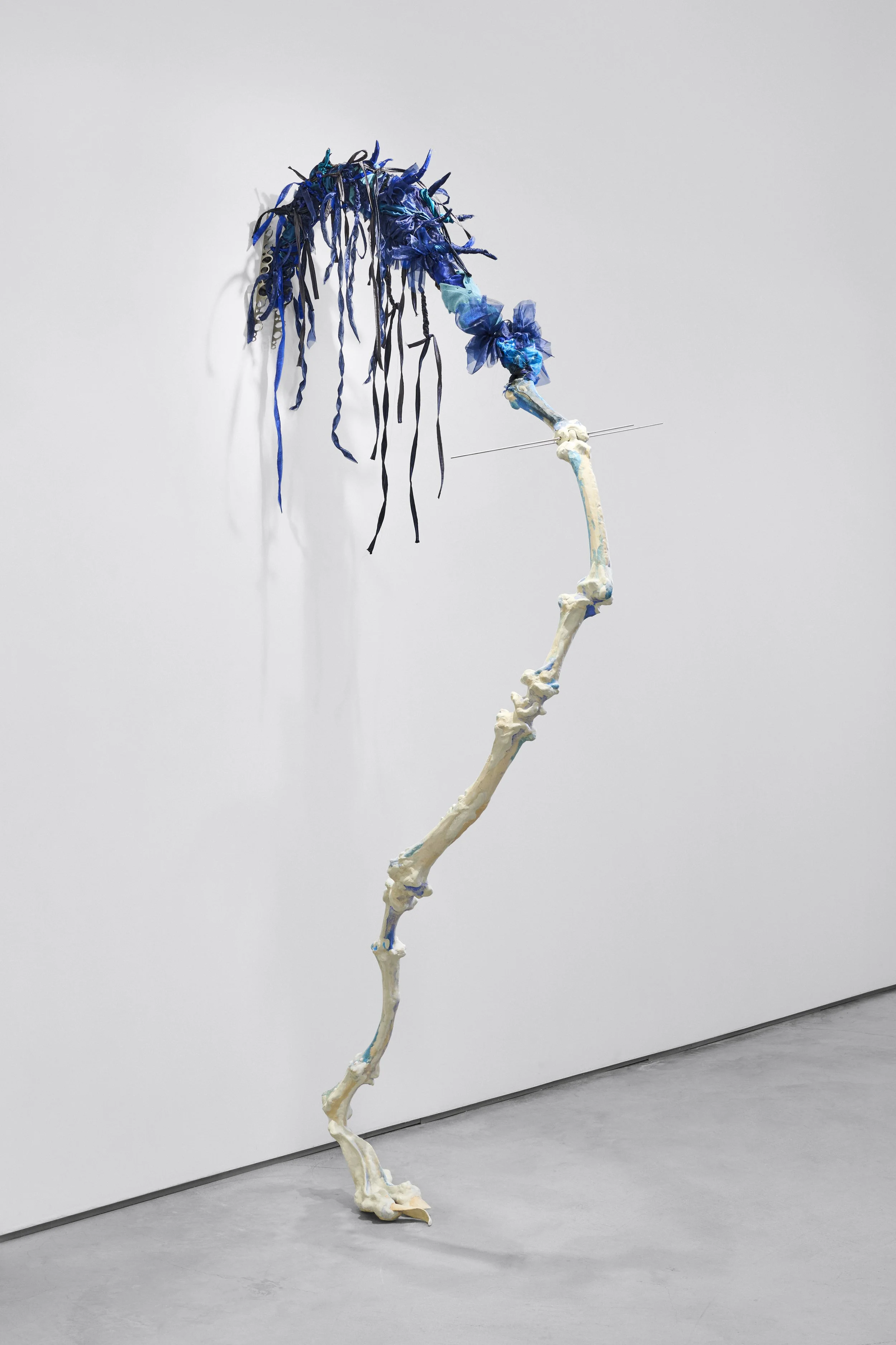
Woo Hannah, Demi-Pointe, Resin, 3D printed PLA, fabric, thread, aluminum wire,(approx.)380 x 107 x 60 cm, 2025. Photograph by Seungheon Lee. © Woo Hannah, Courtesy of the artist and G Gallery
AH: The textile industry carries complex ecological and gendered histories in Korea and beyond. How do you navigate that inheritance while still allowing the material to act beyond its cultural coding?
HW: When fabric arrives in the studio as material, rather than first recalling its history or background, I look at how this material is appearing in front of me now—what kind of “body” it has. It’s a kind of initialization. Instead of simply following along with its classed or cultural meanings, I let its own properties— absorption, transparency, weight, the wear of its surface—speak first.
Depending on how dense or loose the weave is, the cloth affects how the needle can travel back and forth through the front and back of the fabric. Thick yet loose weaves have their own breathability. Some fabrics are so strong that they create curves completely different from what I intended. Those resistances and deviations become special conditions under which new lines and volumes are formed and some being can appear.
I design environments where this material can move “like a body” and have a new ecology. I tighten it or leave it slack, let colour and volume flow, and allow gravity, air, light, and time to intervene so that the form changes. When that happens, the material begins to slip out of its past coding and reveal a vitality of the “here and now.” In the end, my work comes to exist moving between the “history the material has carried” and the “vitality” that the material is trying to manifest anew.
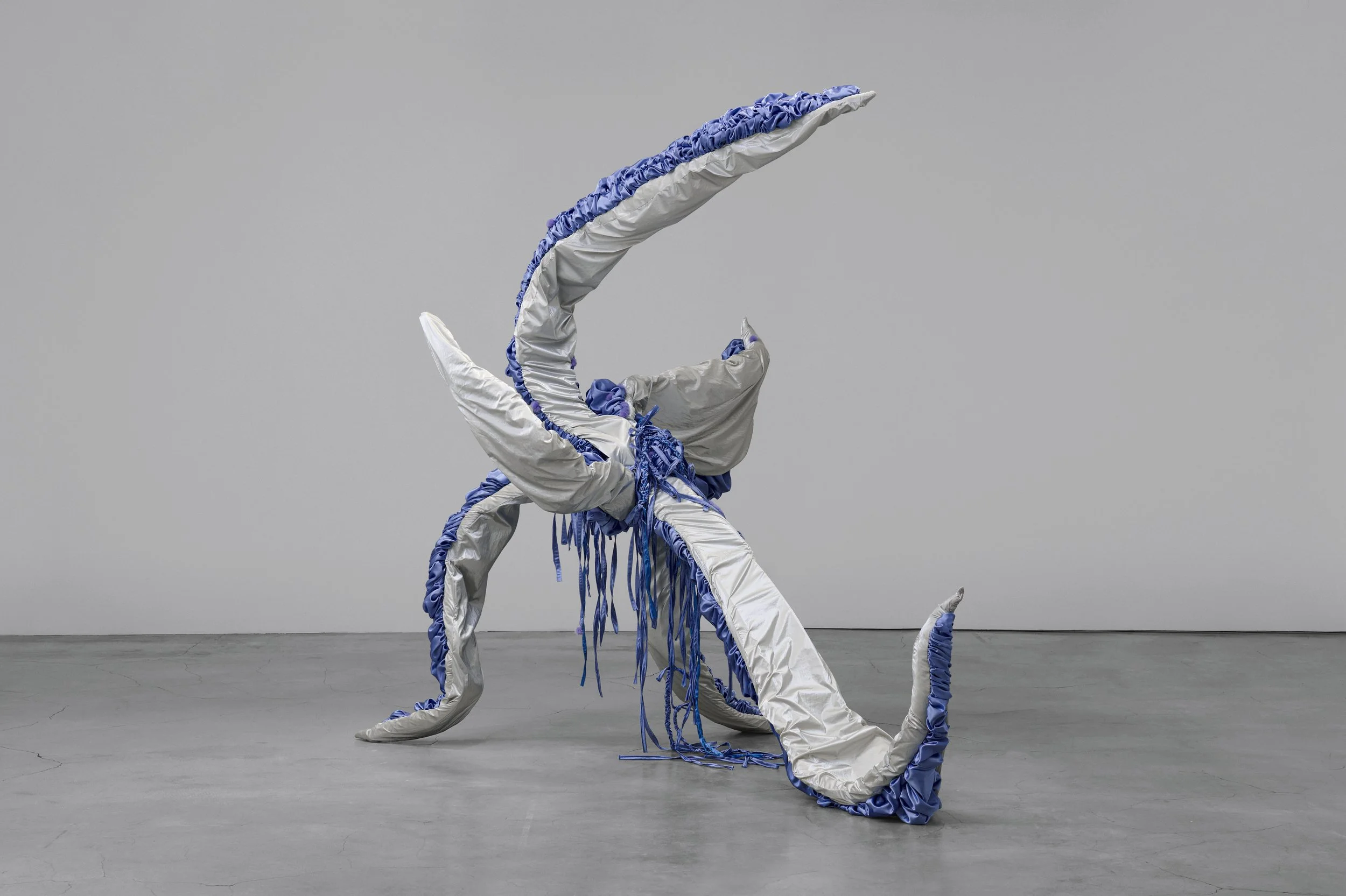
Woo Hannah, Walking Diva, Fabric, stuffing, faux fur, steel frame, 220 x 175 x 240 cm, 2025. Photograph by Seungheon Lee. © Woo Hannah, Courtesy of the artist and G Gallery
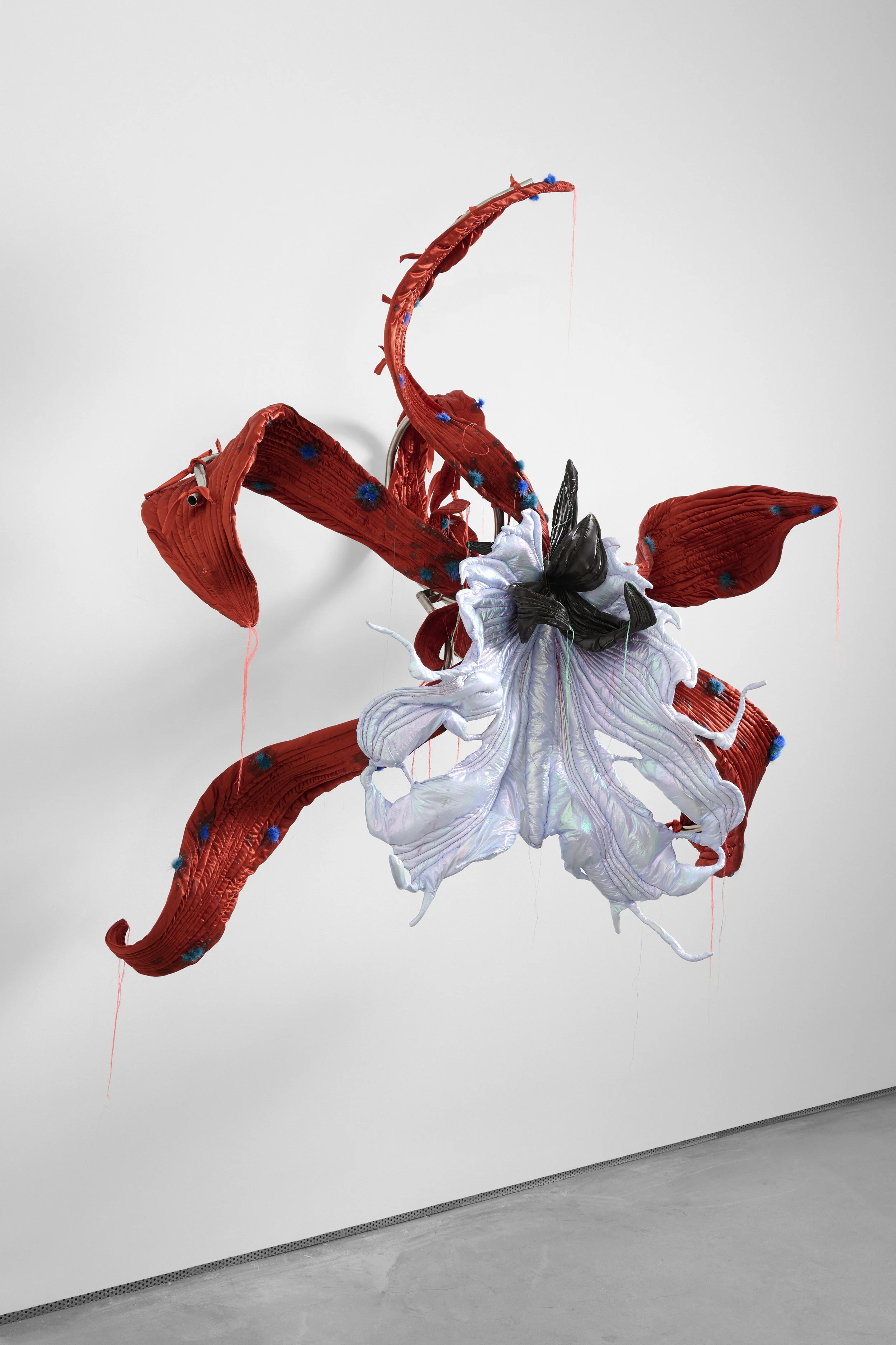
Woo Hannah, Flame Thrower, Lacquer paint on fabric, stuffing, steel frame, 175 x 175 x 94 cm, 2025. Photograph by Seungheon Lee. © Woo Hannah, Courtesy of the artist and G Gallery
AH: Your installations change under light and weight over time. Do you design for this slow drift, or do you let the exhibition space itself complete the work?
HW: I do try to design for it, but I also keep in mind that it won’t always turn out that way. A design is only a design; the area I cannot control is always larger than the area I can control, and it’s unpredictable. When I know a space well, I try to follow the latter more.